
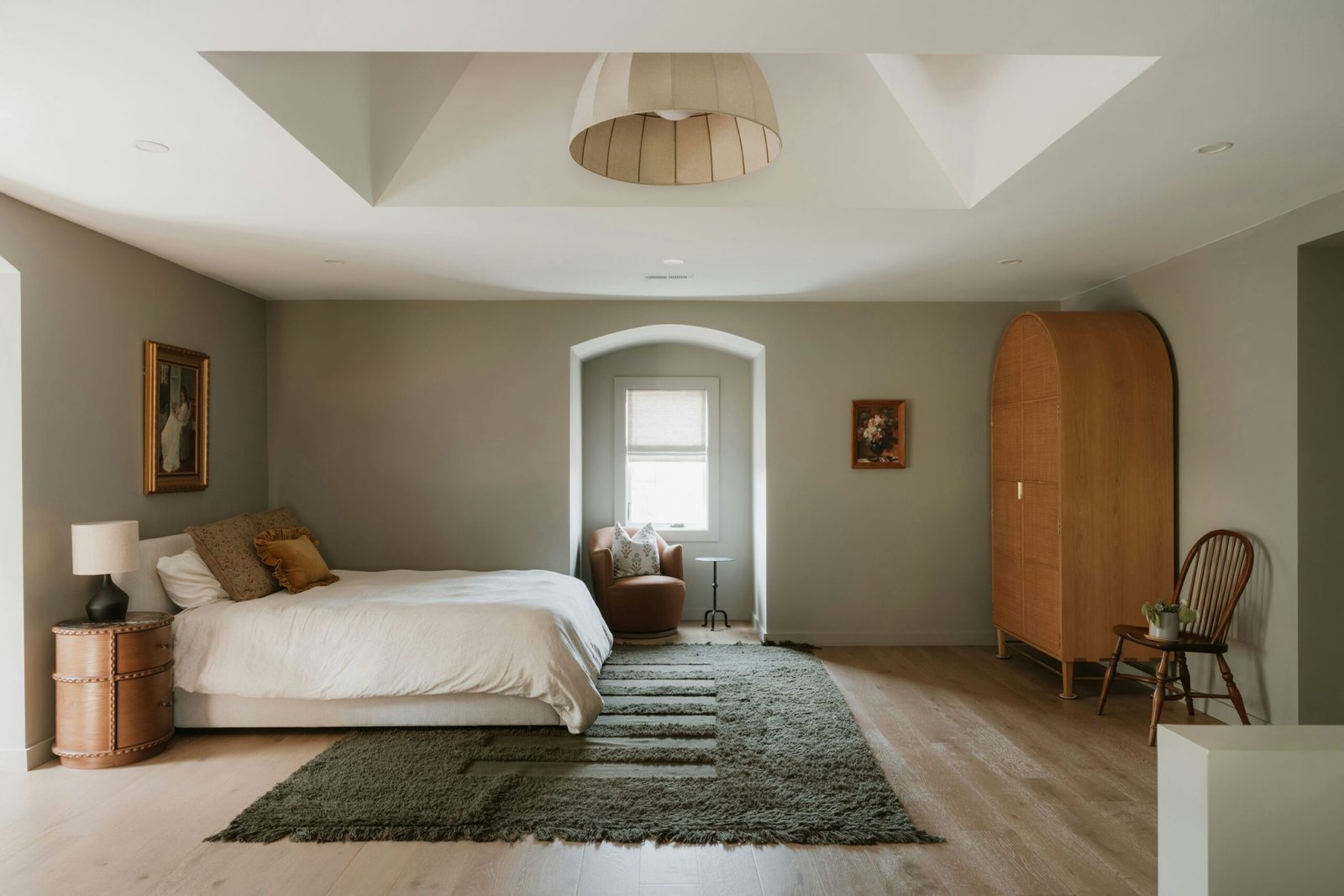
Earthy bedroom ideas can become crowded when every natural color and texture appears at once. Terracotta, olive, and wood work best when you give them different jobs: one leads, one supports, and the third connects the room.
These are broad color families. Compare actual textiles and finishes in your own light before buying or painting.
1Choose the dominant color first
Use olive bedding with a small terracotta accent, or reverse the relationship. Equal amounts of both can compete if their saturation is strong.
2Keep a pale neutral between the colors
Ivory or oatmeal can provide a quieter surface beside olive and clay. Test the neutral against your wall and wood so it genuinely connects them.
3Let the largest wood piece set the direction
A walnut bed and a honey-oak wardrobe create different starting palettes. Include the furniture you will keep in every sample comparison.
4Try terracotta as a folded throw
This gives the color a clear area without committing to painted walls. Move it around the room before deciding how much you want to see.
5Use olive in plain bedding
A large simple textile can provide a calm background for wood grain. Keep the surrounding patterns restrained if the furniture already has substantial detail.
6Add a woven curtain
Texture can strengthen the material palette without introducing another color. Choose care requirements and window operation that fit your everyday routine.
7Introduce brown for depth
A small chocolate accent can link wood with the stronger colors. Test it before adding black automatically to every lamp and picture frame.
8Limit decorative baskets
One useful basket may hold a throw. Several empty baskets can make the room feel staged while consuming floor space needed for movement.
9Keep ceramics on stable surfaces
A small pottery object can contribute shape and texture. Place breakable pieces away from the sleeping area and anywhere they are easily knocked over.
10Let bedding textures differ
Smooth sheets, a quilted coverlet, and a woven throw can share related colors while remaining visually distinct. Choose layers you actually use.
11Repeat an accent in artwork
A muted clay detail in a picture can connect a throw to another wall. Select art you enjoy rather than treating it only as a color swatch.
12Use a rug to bridge finishes
A rug containing warm neutral and muted green can connect floor, bed, and bedding. Check the size and route before choosing the pattern.
13Try a restrained darker green
A deeper olive can give pale wood more contrast. If the room feels heavy, lighten the bedding or curtain area rather than adding many white ornaments.
14Keep metal accents selective
A warm metal can sit comfortably with earthy textiles, but it need not appear everywhere. Work with existing fittings where they already suit the palette.
15Choose plants for their conditions
A plant adds living color only when the location meets its needs. Do not put one in a dim corner merely to complete a natural-looking photograph.
16Test paint beside the textiles
Large sample boards help compare the wall with bedding and furniture. Review daylight and your usual evening lights before approving the combination.
17Simplify a strongly patterned floor
If tile or carpet already contributes a busy motif, keep large textiles plain. Earthy does not have to mean adding another pattern to every surface.
18Leave a clear dresser area
Display fewer, larger useful objects instead of a collection of tiny natural-themed accessories. The furniture should remain practical.
19Review the balance from bed
Look at the surfaces you see while resting, not only from the doorway. Reduce whichever color or texture feels overrepresented from that position.
Three palettes to test
Try olive, ivory, and pale oak for a lighter scheme; terracotta, oatmeal, and walnut for a warmer one; or cream, muted olive, and a small clay accent for a quieter mix.
Browse our terracotta palette guide and olive green decor ideas for related combinations.
Must earthy colors be dark?
No. Pale clay, gray-green, light wood, and cream can create a much lighter interpretation.
Do natural-looking materials all need to be real wood or stone?
No. Choose products honestly described and suitable for your budget and care needs. Appearance alone does not establish material quality or environmental performance.
Keep the palette intentional
Give each material a role and stop adding pieces once the room feels complete. A coherent selection is more effective than collecting every earthy accessory.
Discussion