
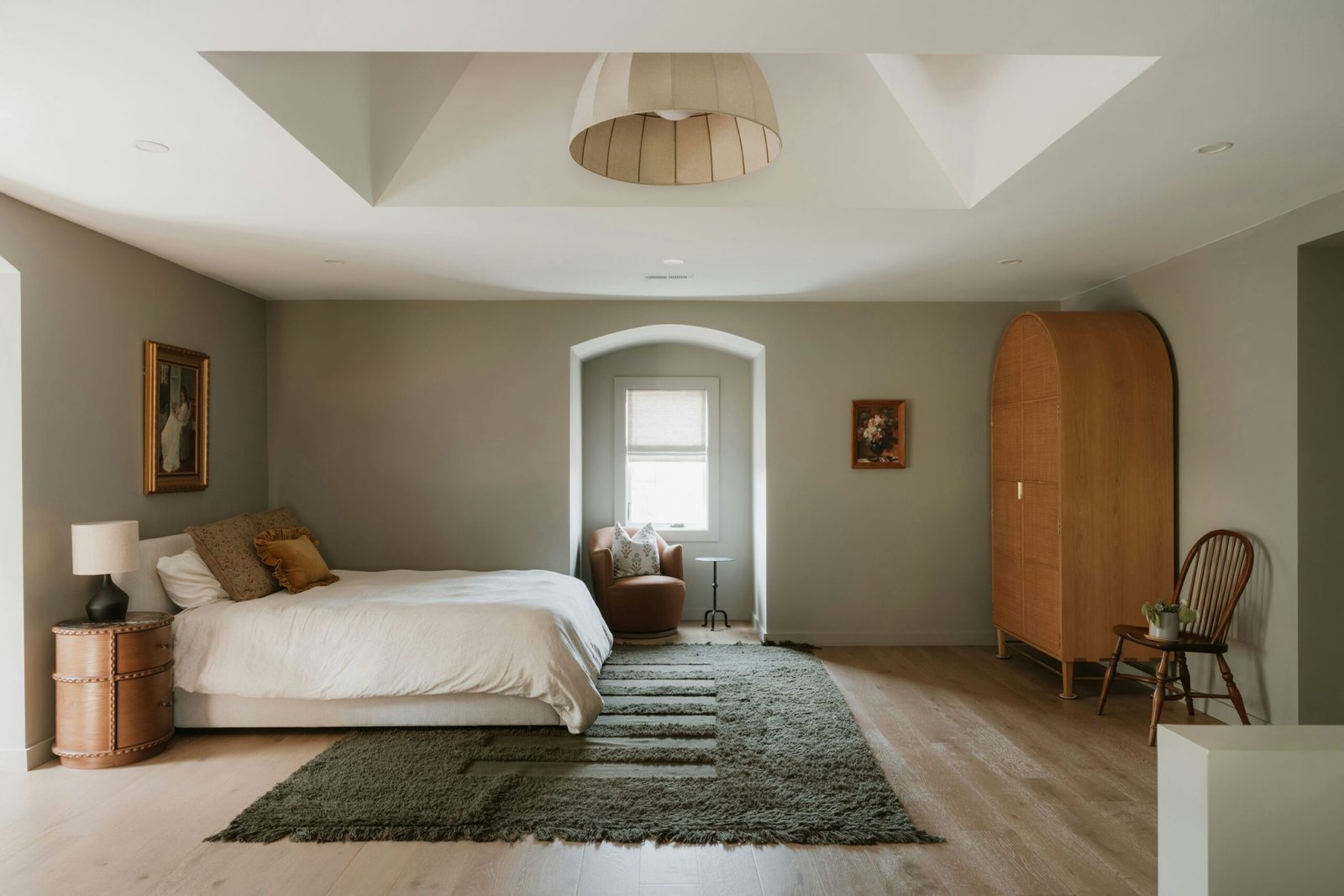
The beige vs greige bedroom question is really an undertone question. Both can create a quiet background, but either can look unexpectedly pink, yellow, green, or cool beside your flooring. Choose the color in the room rather than treating its name as a promise.
Beige usually describes a warm neutral in the tan or cream family. Greige describes a gray-beige blend. The boundaries are loose, and individual paints vary considerably.
| Factor | Beige | Greige |
|---|---|---|
| Typical direction | Warmer tan or cream | Blend of gray and beige |
| Main sample check | Yellow or pink beside fixed finishes | Green, violet, or other undertones |
| Best comparison | Floor, headboard, evening light | Floor, headboard, evening light |
Start with what cannot easily change
Look at the floor, built-in wardrobe, and largest furniture pieces. A fixed gray carpet and an orange-toned wood floor present different starting points. Bring the neutral sample down to those surfaces instead of judging it only against a white wall.
If you plan to keep a large upholstered bed, include its fabric in the test. A paint that coordinates with the floor but clashes with the headboard has not solved the whole room.
When beige is worth trying
Beige can support a warm, softly layered bedroom with cream bedding, brown accents, and natural materials. It is useful when you enjoy a low-contrast palette and want the walls to participate in that warmth.
However, a strongly yellow beige beside yellowish wood can create more warmth than you intended. A rosy beige can also become conspicuous next to a greenish carpet. Test the specific shade; changing from one beige to another may matter more than switching categories.
For a hypothetical room with a walnut bed and ivory curtains, a muted beige may create a gentle transition. Add a darker accent in the bedding or lamp so the scheme still has definition.
When greige is worth trying
Greige can bridge gray elements and warmer furniture, particularly when neither a clear cream nor a straightforward gray looks right. But it is not an automatic cure for mismatched finishes.
A greige with a noticeable green undertone can look different next to a pink-beige headboard. A violet-influenced neutral may appear cooler than expected under your evening lighting. These shifts are reasons to sample, not reasons to avoid the whole family.
If the floor is cool gray and the furniture is warm wood, compare several balanced neutrals before assuming one fashionable paint will connect them all.
Run a three-position sample test
Follow the paint manufacturer’s sampling directions. Place movable samples beside the floor, next to the headboard, and in the darkest usable corner. Review them in daylight and under the lights you actually switch on at night.
Do not surround every sample with competing colors; compare a small shortlist. A sheet of plain white card nearby can help reveal differences, but the actual room remains the decision-maker.
Sherwin-Williams’ guidance explains how lighting changes the undertones you see. Digital room previews can help narrow ideas, but they cannot replace this physical comparison.
Make the bedding do some of the work
If your existing wall color is acceptable, try changing the textile relationship before repainting. An ivory duvet can soften a cool room. A muted blue or brown throw can introduce separation into a beige scheme.
Use texture to keep closely related tones from flattening into one mass. A woven curtain, quilted coverlet, and plain cotton sheet can share a palette while still looking distinct.
Explore our warm neutral bedroom ideas and greige decorating examples to see how layered neutrals can work.
Common questions
Is greige more modern than beige?
Neither color family belongs to one style. Furniture shape, contrast, lighting, and materials strongly affect the result. Choose the combination you want to live with rather than a label associated with a trend.
Can beige walls work with gray bedding?
Yes, when their undertones and surrounding materials relate well. Compare the bedding physically against the paint and add a bridging textile if the contrast feels disconnected.
Make a small decision first
Approve the neutral beside the floor and bed before buying coordinated accessories. A successful bedroom palette starts with compatible large surfaces, then gains personality through smaller choices.

Discussion